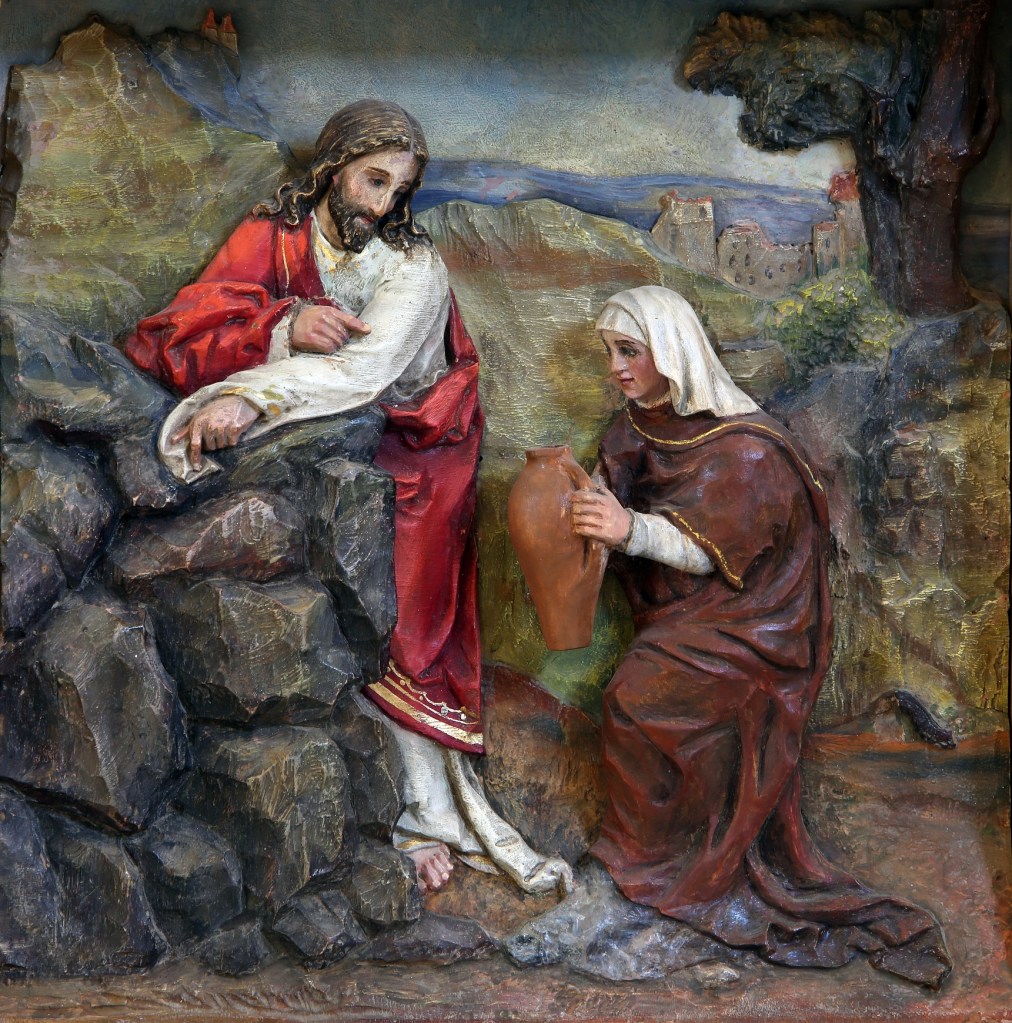
(Following is an excerpt from Glen Argan’s book, Jesus Christ: The Heart of Vatican II.)
The dialogue between Jesus and the Samaritan woman by Jacob’s well is one of the longest conversations in the Gospels. The woman slowly comes to understand what Jesus means by “living water,” and so she wonders whether he may be the Messiah.
When she returns to her city, she tells the people, “Come and see a man who told me everything I have ever done.” If indeed Jesus did describe everything in the woman’s life, the conversation must surely have lasted much longer than what’s recorded in John’s Gospel. Most of what Jesus told her appears to be missing.
However, that shouldn’t concern us who read the Gospel story. We are not interested in the fine details of the woman’s decades-long life. What’s striking is the great attention Jesus paid to this woman, an outcast in her own community, a community despised by Jesus’ own people. Perhaps the conversation stretched for hours until the disciples returned. What a wonderful gift that otherwise unfortunate woman received! The Savior of the world gave her his undivided attention for a long period.
We might even be a little jealous of her. Oh, that Jesus might have a long, intimate conversation with me too. Yet we can count on Jesus to have such conversations with each of us and to show his incredible mercy as well. We may have to wait until we die for that experience. Instead of meeting Saint Peter at the pearly gates, we may have a sit-down with Jesus himself. He’ll review our lives and recount not only our sins, but also the generous, loving acts we’ve done with him and with other people.
However, we need not wait until we are dead. Jesus has begun the conversation already. He has given us God’s word, comes to us in the sacraments and listens intently when we come to him with our joys and hopes, grief and anguish. Jesus wants us to play our role in that conversation so that, on this side of the grave, we may walk alongside him, bearing fruit for the eternal reign of God.
The Second Vatican Council made Christ the source of its teaching on the Church. The council’s Constitution on the Church (Lumen Gentium) begins this way: “Christ is the light of the nations.” (LG 1) Christ, not the Church. More than that, even those who don’t know the Gospel, but who seek God are “moved by grace” and may attain eternal salvation through Christ. If Christ is the light of the nations, that light also shines in those who search for an unknown God “in shadows and images.” (LG 16) Was not the Samaritan woman like that? Was not her restless life a matter of searching for God in shadows and images?
The first draft of the document on the Church presented to the council spoke of the Church as an institution of power characterized by authority and obedience. The bishops received that draft with coolness. Cardinal Giovanni Battista Montini of Milan was the one who told the council that Christ alone gives light to all people. The Church reflects that light. It is not the sun but the moon.
Unless the Church is rooted in and led by Christ, it is only a human structure. The council fathers understood the priority of Jesus, thus implicitly acknowledging the relativity of the Church’s structures. Jesus is the same yesterday, today and forever. However, the Church that proclaims Jesus can change. Vatican II’s Constitution on Divine Revelation (Dei Verbum) reflected that new vision. It spoke personally: “The invisible God, from the fullness of his love, addresses men and women as his friends, and lives among them in order to invite and receive them into his own company.” (DV 2)
What a beautiful and striking difference that is! Who could not be drawn to a loving God who invites us to be his friends and who walks at our sides?
Christ is not only attractive but transforming. Through the light of his presence and attention, he illuminated the Samaritan woman’s life. She understood both God and herself more fully now since all was seen in the light of Christ’s love and mercy.
Gaudium et Spes (The Pastoral Constitution on the Church in the Modern World) sums up the meaning Jesus has for us and for humanity: “The Lord is the goal of human history, the focal point of the desires of history and civilization, the center of humanity, the joy of all hearts and the fulfillment of all aspirations.” (GS 45) For us, Jesus is everything.
Several months after his intervention at the council, Montini was elected pope and took the name Paul VI. When he addressed the opening of the second session of Vatican II in September 1963, he proclaimed, “Let this present assembly of ours shine with no other light than that of Christ, who is the light of the world.”
What does it mean for Christ to be the light of the world?
To be a Christian is to encounter a living person, Jesus Christ. Those who encounter Christ and become immersed in him mirror Jesus to the world. They trod where he walked. Christ charges the People of God to shine his light everywhere – in our homes, in our schools and legislatures, among the dying and destitute, to those who are poor and to those who think they are rich.
Christians know God loved each of us with a reckless love of self-abandonment. Encountering Jesus is like meeting no other human being. The encounter tosses us off our feet and expands our vision and heart like no other relationship. In Christ, we become a new creation. God became human so we might become human in a way previously unimaginable.
The question of why God became human is foundational. The Catechism of the Catholic Church gives a fourfold response. The first reason was the one we most often hear – that through his sacrificial death, the Son of God would atone for our sins. God has the negative purpose of saving us from hell. However, God also wanted to bring us into his presence eternally. So the second response to the question is that “The Word became flesh so that thus we might know God’s love.” God demonstrated his love for humanity by drawing close to us.
Third, Jesus urged the people of Judah, “Take my yoke upon you, and learn from me.” (Matthew 11.29) Jesus is the perfect model for living in union with the Father. Finally, by becoming human, God enabled us to share in his divinity, a startling proposal but one taught by saints and the fathers of the Church.[1]
Divinization is our highest calling. Our humanity is united with Christ’s divinity. To know Jesus is to walk down a trail toward union with God. That’s the meaning of creation, a meaning hidden until Christ revealed it through his life, death and resurrection.
This meaning is not subjective. Christ brought salvation for all. We can choose to reject him, but we can’t choose the consequences such a rejection will have for our lives. One may be unable to perceive Jesus’ divinity and his mission of salvation. Yet if one dedicates their life to pursuing truth and goodness, they still share in Christ’s act of redemption.
Who was Jesus? First, he was the divine Son of the Father who became fully human, suffered, died and rose bodily to new life. If this is not true, then Jesus does not matter. He is just another prophet who spoke words that one can accept or reject. But if Jesus is divine, he reveals much about God.
Jesus reveals God as the God of mercy who calls all people to repentance and offers forgiveness. Further, he calls us to forgive others, and in doing so, we become more God-like. Christ associated primarily with ordinary working people, women, the poor and all forms of outcasts. He condemned the religious elite of his day for making religion a tool for domination. Jesus rejected violence and willingly accepted his own death at the hands of the Roman imperial power.
If Jesus were here today, he would again condemn the idea that God is on the side of anyone who makes war for whatever reason. He would turn his back on the prayers some offer for military victories and personal enrichment.
Jesus preached the reign of God, a kingdom where our relationship with God takes absolute priority over worldly honors, money and personal autonomy. The kingdom is the eternal life nurtured through our words and actions in this world and that reaches its culmination in an everlasting union with the Trinity. Nevertheless, this kingdom is a force for liberation from the evils of this world, primarily personal sin, societal oppression and death.
The divine Jesus outstrips all our imaginings and all our attempts to place limits on him. He bursts through the clamor and emptiness of life and reveals that God is self-sacrificing love. He wants us to be lovers too. God can enter our lives and turn them upside down. God offers us the grace of faith, giving us the freedom to accept or reject his love.
The God of history and the Bible and the transcendent God above the heavens are the same God. But the God of history is the God with whom we can have a personal relationship. God invites each of us to be his friend.
Repeatedly, the Vatican II documents refer to Christ’s incarnation and passion, death and resurrection in terms of kenosis – a self-emptying. Christ emptied himself of his divinity and, as a human being, humbled himself to the point of accepting death on the cross. (Philippians 2.6-8)
Jesus rejected earthly glory and, in doing so, offered us an example. “Christ Jesus, ‘though he was by nature God . . . emptied himself, taking the nature of a slave,’ and ‘being rich, became poor’ for our sake.” (LG 8)
We stand in awe of God the Almighty. We can worship the Almighty, but loving such a God is difficult. He is far away. The God who shared our sufferings is lovable in his weakness. Far from being puffed up with his divine status, Jesus sacrifices himself for all. This image offers a stark contrast with a culture of self-importance, fierce competition and what Pope John Paul called “superficial unilateral freedom.”[2]
Jesus’ ways and the ways of the world are at odds. We can’t have it both ways. Either I put myself first or Jesus first. Yet why would we put Jesus first unless we know him? An encounter with Christ is of utmost importance. Jesus is already seeking us out. He comes to us gently, and we need special eyes to see him. God grant us the favor of divine vision.
[1] Catechism of the Catholic Church, 457–60.
[2] Pope John Paul II, Redemptor Hominis (The Redeemer of Humanity), 1979, 12.


